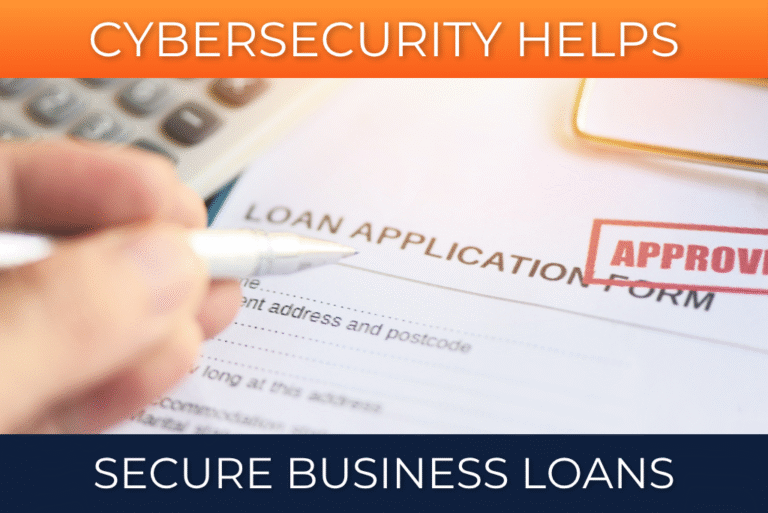
If you’re looking to get approved for a business loan in the near future, you’re probably going to consider the obvious factors that most business owners consider: revenue, credit history, cash flow, time in the business, and overall collateral.
Those things absolutely matter when it comes to securing a business loan, but they’re no longer the only thing that matters to lenders for business loans.
Today, lenders are paying closer attention to operational risk and business resilience. Why? Because cyberattacks, fraud, and downtime can seriously impact a company’s ability to operate and repay debt.
That means that your business’ cybersecurity practices and procedures actually plays a larger role in your business credibility than you may have realized.
Why Lenders Care About Operational Risk
We’ve talked to our friends over at the First National Bank in Tannersville, PA, about how they walk through the lending approval process, and for them, cybersecurity plays a sizeable role in a business’ chance to secure a loan.
Modern businesses rely heavily on technology for communication, accounting, customer data management, payment process, file storage, and so on. With technology so integrated into the lifeblood of the business, if any of those systems become unavailable or compromised, then operations slow or completely grind to a halt.
With the advancement and evolution of cyberattacks, like targeted ransomware or AI-powered phishing emails, one compromise in a business’ systems can cause a whole slew of issues. Not only does your business technology experience extended downtime, but revenue is also lost or might be stolen by cybercriminals. On top of these upfront costs, there are extensive recovery costs, which on average cost a business between $120,000 all the way up to $1.24 million! And to put the cherry on top of this disaster, an SMB loses reputation, deals with compliance issues, and opens themselves to potential lawsuits.
In fact, almost 60% of small businesses close within 6 months of a cyberattack. If these businesses fold, then how will they pay the lender back?
That’s why, from a lender’s perspective, cybersecurity and operational risk matter for your business’ chance to secure a business loan.
How to Bulk Up Cybersecurity for Your Business Loan
With such an important financial decision and commitment, it’s important that your business takes every precaution to put in place proper defenses. While working with a Managed Service Provider (MSP) will give you the best and most up-to-date defenses, there are plenty of things you can do today to bulk up your cybersecurity right now.
- Enable Multi-Factor Authentication (MFA) on Critical Accounts – MFA is one of the simplest improvements that you can implement right now, and it’s totally free. MFA requires users to verify their identity with an additional step beyond just a password, helping to reduce unauthorized access.
- Strengthen Backup & Recovery System – Lenders want confidence that a business can continue operating if something goes wrong. Reliable backups help business recover from ransomware attacks, hardware failures, accidental deletions, and even natural disasters. To get a stronger system in place, you can consider automated backups, cloud-storage solutions, regular recovery testing, and multiple backup copies.
- Train Employees on Cybersecurity Awareness – Regardless of the strength of your defenses, many cyber incidents begin with human error. Training employees gives them the tools to recognize a variety of phishing emails and vishing calls.
- Update, Update, Update – Outdated systems are one of the most common security weaknesses in small businesses. Taking the time to install regular updates and patches protects against known vulnerabilities, malware attacks, compatibility issues, and exploits. Every device your business utilizes should get this, including desktops, laptops, servers, firewalls, software, and even cloud applications.
- Develop a Basic Business Continuity Plan – What happens if your business suffers a cyberattack or even an outage caused by hardware malfunctions? A basic business continuity plan outlines how operations continue during unexpected disruptions, and it outlines procedures, communication plans, remote work capabilities, and more.
By doing just these 5 simple practices, even without ongoing support from an internal or external team, your business has implemented practical cybersecurity defenses that help show business maturity and set you up for the long haul. If you want some more in-depth information on the biggest risks, check out our notes on Cybersecurity for Business Owners in 2026.
Cybersecurity Matters Beyond the Loan
While securing the right loan is the short-term goal, cybersecurity helps position your business for the future. By continuing to do the 5 tips above, you help protect your business investments.
There are more in-depth cybersecurity measures that reduce your cyber risk even further, such as Advanced Endpoint Detection and Response (EDR), dark web monitoring, and even 24/7 detection software. With these solutions, it’s best to partner with a dedicated Managed IT Services Provider who can help you establish robust cybersecurity defenses.
While strong cybersecurity won’t replace strong financials, it will protect what matters most. At Marvel IT Services, we specialize in helping business tackle proper, strong cybersecurity that helps them secure small business loans from lenders, and we help build a technological environment that helps propel that loan into accelerated growth supported by technology, not hindered by it.
If you want to build a better cybersecurity position today to protect your business’ tomorrow, let’s set up a free technology and business assessment.